
Getting around Cyprus without a car: bus, taxi and transfer compared
16 July 2026
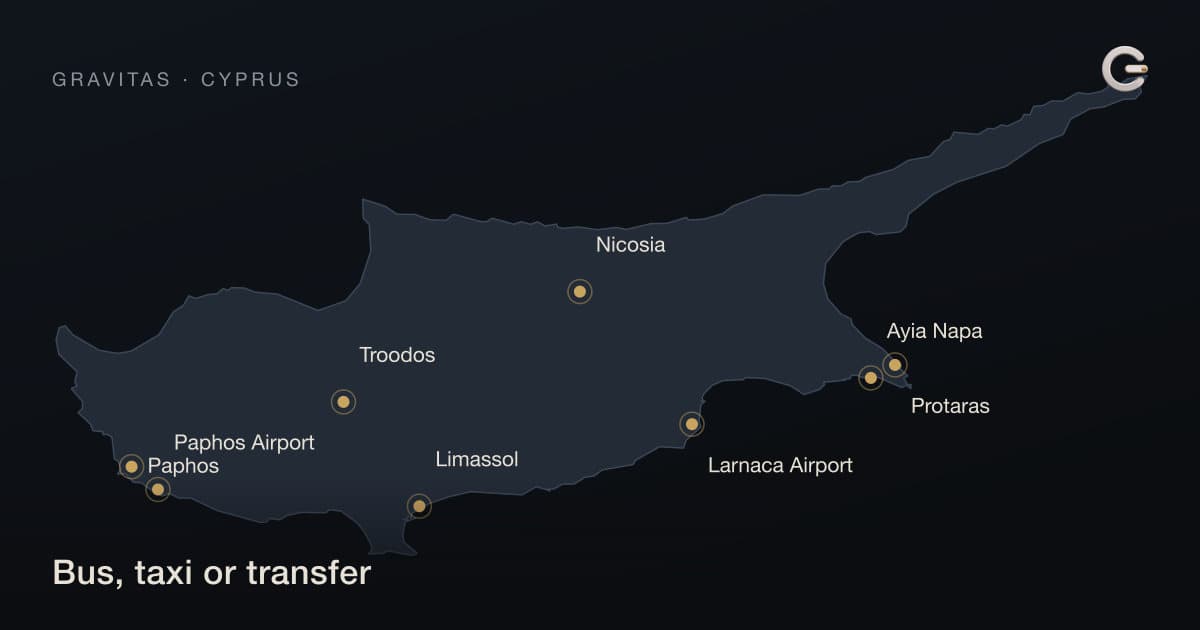
You can see Cyprus without hiring a car, but you have to plan around three facts: there is no passenger railway, intercity buses stop early in the evening, and the island is bigger than the map suggests — Paphos to Ayia Napa is a two-hour drive. Buses handle the cheap daytime hops between cities. Taxis cover short local rides. Pre-booked cars cover airports, luggage and anything after dark.
The bus network, honestly
Buses in Cyprus split into two layers, and confusing them is the usual mistake.
Intercity coaches connect Nicosia, Limassol, Larnaca, Paphos, Ayia Napa and Paralimni. They are cheap, air-conditioned and reasonably punctual. They also run to a modest timetable, drop you at a bus station rather than your hotel, and thin out sharply on Sundays and public holidays.
Urban and district buses run inside each city and its surroundings — a different operator in each region, its own routes, its own timetable. In Limassol these follow the coast well; in the resort areas they get you along the strip. They are not designed to move a family with suitcases.
Two practical rules. First, check the last departure before you commit to a day trip: evening services are thin and the last coach can be earlier than you expect. Second, buses do not go to the villages worth seeing. Anything in the Troodos foothills, the Akamas, or a winery, is off the network.
Taxis
Cypriot taxis are metered and easy to find in the cities, at the airports and outside the big hotels. For a fifteen-minute local ride they are the obvious answer.
Two things to know. The meter has tariff bands, and the evening band is more expensive — which matters on longer runs, not on a hop across town. And rural taxi services outside the cities are thinner than you would expect; do not assume you can flag one down in a village at nine in the evening.
Pre-booked transfers
This is the same product as a taxi, decided in advance instead of at the kerb. You give the route, you get one price, a car is assigned and it turns up.
It earns its money in four situations:
- Airport runs, where you land with luggage, possibly at 01:00, possibly two hours late. Flight tracking means the car is there anyway, and airport waiting is free for 60 minutes after the plane lands.
- Long crossings. Larnaca to Paphos is 135 km. A meter running for an hour and a half produces an unpredictable number; a booked car is €130 for a sedan.
- Groups and families. A V-Class takes six people and up to eight suitcases in one vehicle — how many fit depends on their size. Buses and small taxis turn that into a logistics exercise.
- Anything after the buses stop. A booked car has its price agreed up front, so a 02:00 arrival costs the same as a midday one.
Hiring a car: when it makes sense
If you want the mountains, the Akamas peninsula and the villages, hire a car. Just know what you are signing up for.
Cyprus drives on the left — a genuine adjustment for most European visitors, and the first hour is the one to be careful in. Motorways are toll-free, which is a pleasant surprise. Distances are short. Against that: parking in central Limassol and old Nicosia is a real problem, mountain roads are narrow and slow, and a hire car is a poor idea on the day you fly out with an early flight.
The common compromise works well — transfer in from the airport, hire a car for the two or three days you actually want to drive, transfer out.
What things cost
| Route | Bus | Booked sedan | Booked minivan |
|---|---|---|---|
| Larnaca Airport → Ayia Napa | a few euro, with a change | €50 | €90 |
| Larnaca Airport → Limassol | shuttle, daytime only | from €70 | from €100 |
| Limassol → Nicosia | intercity coach | €80 | €145 |
| Limassol → Troodos | not practically served | €40 | €75 |
| Paphos → Ayia Napa | 2 changes, 4+ hours | €175 | €310 |
The bus column is deliberately vague on price — operators set their own fares and change them, so check the current timetable. The pattern holds regardless: buses win on money for simple city-to-city daytime travel, and lose everywhere else.
Five things to plan around
- The airport is not the city. Paphos Airport is a 15-minute drive from Paphos town; Larnaca Airport is outside Larnaca. Neither is walkable.
- Sunday is a quieter timetable. Assume fewer buses, everywhere.
- The north is a separate journey. Crossings exist but a hire car's insurance often does not cover them — check before you plan.
- Book child seats in advance. They are free with us, but they are fitted before the car sets off — a request made on arrival cannot be met.
- Say it up front if your luggage is unusual. Golf clubs, skis, a bike box, a wheelchair. The vehicle is chosen around it and the price agreed beforehand.
FAQ
Can you manage in Cyprus without a car?
Yes, if you stay along the south coast and travel mostly in daylight. Intercity buses link the main cities cheaply; transfers cover airports, evenings and luggage. For the mountains and the villages you need a car — hired or booked with a driver.
Are there trains in Cyprus?
No. The island has no passenger rail service; road transport is all there is.
Do buses run late at night?
Not usefully. Intercity services finish in the evening and urban routes thin out with them, which is why late arrivals and late returns are normally done by car.
Are Cyprus motorways toll-free?
Yes. There are no road tolls, so a longer motorway route costs you nothing extra beyond fuel or the agreed fare.
Plan the moves that matter
Airport arrivals and long crossings are the trips worth fixing in advance. Prices for every route are on the transfers pages — pick your two points and the fare is there before you commit.